
Breast Augmentation (Breast Implants)
Many women choose breast augmentation to feel at ease in a swimsuit or a fitted top and more confident in their shape. Women from Seattle and across the Eastside choose Anderson Sobel Cosmetic Surgery and Bellevue cosmetic surgeon Dr. Alex Sobel. He starts by learning your aesthetic goals, then matches the implant to your anatomy for a natural-looking result.
Breast augmentation, also called breast implant surgery or augmentation mammoplasty, adds volume and can restore fullness lost after pregnancy, breastfeeding, or weight loss. Dr. Sobel is triple board-certified in general cosmetic surgery, facial cosmetic surgery, and otolaryngology-facial plastic surgery, and has performed thousands of cosmetic procedures, including breast implant surgery and using your own fat to add volume (fat grafting).
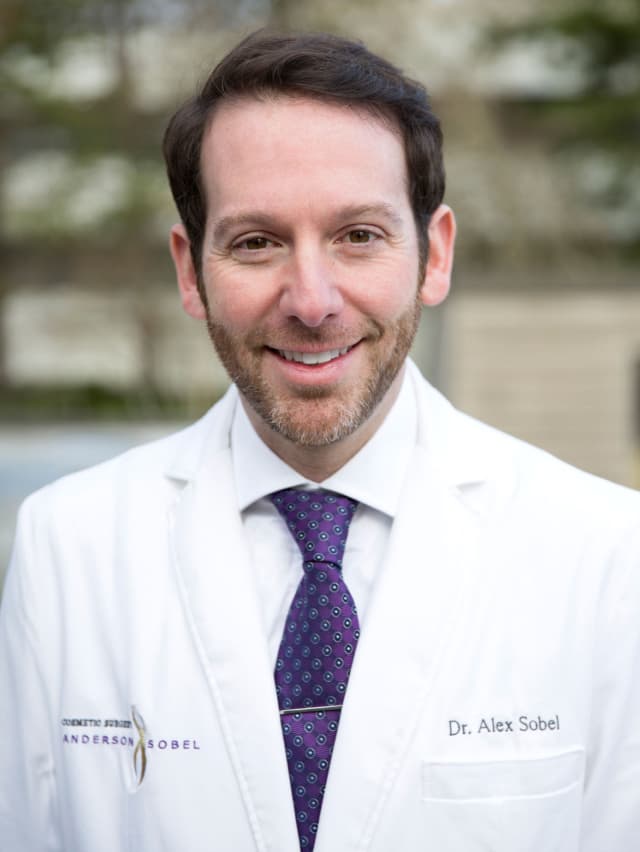
- Triple board-certified in general cosmetic surgery, facial cosmetic surgery, and otolaryngology-facial plastic surgery
- 15+ years of experience specializing in cosmetic surgery
- Operates in an on-site accredited surgical suite for patient safety and privacy
- National leader in cosmetic surgery, including as Past President of the American Board of Cosmetic Surgery and the American Academy of Cosmetic Surgery, and as an expert speaker at medical conferences
- Former Seattle Met Top Doctor with hundreds of 5-star patient reviews
Special Offer for Breast Enhancement Patients
Here at Anderson Sobel Cosmetic Surgery, our primary goal is making sure our patients feel well taken care of, comfortable, and thrilled with their experience and results. We know recovery can be a tough time emotionally and physically, so we want to treat our breast enhancement patients to a special gift (and a little pampering!).
After your breast enhancement procedure with breast implants, we want to offer you a choice of one complimentary treatment or product:
- Love your lips: one FREE syringe of lip filler
- Lose your lines: one complimentary wrinkle relaxer treatment
Limited time offer available to patient who have completed a breast enhancement procedure with breast implants. Contact us today to book your breast augmentation and claim your gift!
What is breast augmentation?
Breast augmentation is a cosmetic surgery that increases breast size and fullness with silicone or saline (salt water) implants, or with a patient’s own fat. Dr. Sobel plans each one for a natural look and proportions that suit your body.


Am I a good candidate for breast augmentation?
Good candidates for breast augmentation are in good general health, have fully developed breast tissue, and have realistic expectations. The FDA has approved saline implants for women 18 and older and silicone implants for women 22 and older.
Three of the most common reasons women choose breast augmentation are breasts that differ in size, volume lost after pregnancy or weight loss, or breast tissue that never fully developed. Implants add volume but don’t raise the breasts. Women with significant sagging often do better with a breast lift with augmentation, which pairs implants with a mastopexy, the surgical lift that raises the breasts. Dr. Sobel’s take on who needs a lift is in the video below.
Video transcript »
“The question of who needs or doesn’t need a breast lift with an augmentation is a wonderful one, but generally women know. I don’t mean to trivialize things because we look at measurements, we look at body proportions, and there are a lot of things that we can use to guide a patient in that matter, but ultimately the decision is theirs. Some women tolerate a lower breast position than others, so strictly speaking breast lifts aren’t needed, they’re desired” – Dr. Alex Sobel, cosmetic surgeon
Why women choose breast augmentation
Asymmetry of the Breasts
Most women have some difference between their two breasts, and for some that difference is easy to see in clothing. Dr. Sobel can improve asymmetry by using a different implant size on each side.
Loss of Volume or Shape in the Breast
Pregnancy, breastfeeding, weight loss, and age can all empty out the upper breast. Implants can bring that fullness back. If the breasts have also dropped, a lift may be part of the plan.

Tuberous or Underdeveloped Breasts (Hypoplasia)
Tuberous breasts are a difference present from birth (congenital) that becomes noticeable as the breasts develop. They can look narrow or tube-shaped, in one breast or both. Augmentation can add volume and improve the shape, and Dr. Sobel will tell you plainly what your anatomy allows.

“I have to say that my experience here was off the charts! I am absolutely AMAZED with the results of my breast augmentation! My confidence has skyrocketed! Not only that, the recovery was SO FAST! When he said a week, he was not joking. I love the vibe and knowledge of the Sobel team! I am already thinking of what I’ll get done next. Thank you for doing such a great job!!!!”
Breast implant options: type, size, placement, and scar location

Four decisions determine how your breast augmentation looks: implant type, size, placement, and where the scar goes. Dr. Sobel works through each one with you at your consultation.
Silicone vs. saline breast implants
- Silicone implants are filled with a cohesive silicone gel that looks and feels close to natural breast tissue. Most of Dr. Sobel’s patients choose silicone implants, as he explains in the video below. Learn more about silicone gel-filled breast implants.
- Saline implants are filled with sterile salt water and can be filled after placement, so the volume can be fine-tuned during surgery.
Fat transfer breast augmentation
Fat transfer breast augmentation uses your own fat, taken by liposuction from another area, instead of an implant. It suits patients who want a modest increase. Dr. Sobel co-authored a 2019 article on the safety of fat grafting for buttock (gluteal) augmentation in The American Journal of Cosmetic Surgery and offers fat transfer as its own procedure.
Choosing your implant size
As a general guide, about 200 cc (cubic centimeters) equals one cup size, but anatomy changes that math. Dr. Sobel also measures base width (how wide the implant sits on your chest) and profile (how far it projects). Those two measurements decide whether a given size looks natural on your frame.
Where your breast augmentation scar will be
Most patients choose one of three approaches, each placed to keep the scar out of sight:
- Around the areola (periareolar): along its lower edge, where the darker skin meets the breast.
- Under the breast (inframammary): in the crease where the breast meets the chest.
- In the armpit (transaxillary): in a natural skin crease, so no scar sits on the breast itself. Most of Dr. Sobel’s patients choose this approach.
Video transcript »
“Patients have a choice in my practice of where their breast augmentation scar will be. Most patients choose the armpit because it tends to be the most concealed with the least amount of attention and just about everybody has a naturally appearing skin crease in that area. However, some patients do choose the underneath the breast fold incision or around the nipple, and rarely patients will make a selection for a belly button incision. However, that is only useful for saline implants, and in my practice in the Seattle Bellevue area, most of our patients choose silicone implants.” – Dr. Alex Sobel, cosmetic surgeon
Implant placement: above or below the muscle?
Dr. Sobel places implants under the chest muscle (submuscular), above the muscle beneath the breast tissue (subglandular), or above the muscle beneath the fascia, the thin tissue that covers the chest muscle (subfascial). Above-the-muscle placements tend to recover faster. Placement affects both the look and the pace of recovery, so he recommends a position based on your tissue and the result you want.
What happens during breast augmentation surgery
Breast augmentation takes about one to two hours. Dr. Sobel uses medicine that puts you fully asleep (general anesthesia) or relaxing medication given through a vein (IV anesthesia), places the implant through the approach you chose together, and closes with stitches (sutures).

What will recovery be like after breast augmentation?
Plan to rest for two to three days. Walking for 30 minutes, three times a day, starts right away and supports healing. Tenderness and swelling are expected, and you’ll go home with medication to keep discomfort manageable. Avoid vigorous activity for six weeks and chest exercises such as push-ups for at least 12 weeks. Dr. Sobel sets your return-to-work date at your consultation.
Video transcript »
“Breast augmentation recovery is completely predicated on the type of procedure that patient has chosen for augmentation, first and foremost. There are some patient factors that may lead to a faster or slower recovery, but in general the techniques that involve above-the-muscle placement of the implant and underneath-the-fascia placement of the implant tend to result in the fastest recovery. In general some of those patients will return to work three to five days after the procedure. The slower recovery procedures or the under-the-muscle techniques are where patients oftentimes won’t feel comfortable with with moderate activity or return to work place in about seven to fourteen days” – Dr. Alex Sobel, cosmetic surgeon
What about breast augmentation scars?
Breast augmentation scars are short and expertly placed where they are hard to see. How a scar heals depends on skin tone and elasticity. Following Dr. Sobel’s aftercare plan, including scar ointment, gives a scar the best chance to fade.
View real patient augmentation results
Explore our gallery of before and after photos to see real patient’s results from breast implant surgery.
“Dr. Sobel and his staff have a way of making you instantly comfortable. Sobel is a master of his craft, and pioneer, and will provide an honest and thorough assessment of any procedure you may be looking to pursue.”
- Key Benefits
- Glossary
- Enhanced Breast Size: The increase in breast size and volume can help women achieve a more proportionate body shape.
- Improved Breast Symmetry: Breast augmentation can correct natural asymmetry, where one breast is noticeably smaller than the other, leading to a more balanced appearance.
- Better Body Proportions: By increasing breast size, the procedure can help balance a woman’s figure, enhancing the overall body shape and proportions.
- Restoration of Breast Volume Post-Pregnancy or Weight Loss: Pregnancy, breastfeeding, and significant weight loss can lead to a loss of breast volume; augmentation can restore this lost volume.
- Expanded Clothing Options: Many women find that clothes fit better and are more flattering after breast augmentation, thus expanding their fashion choices.
- Reconstruction After Mastectomy: Breast augmentation can be part of reconstructive surgery after a mastectomy, helping to restore the breast’s appearance.
- Anatomical Implants: Also known as teardrop or contoured implants, these are breast implants designed to mimic the natural shape of the breast, with a sloped contour that fills out more at the bottom.
- Areola: The pigmented skin surrounding the nipple. Breast augmentation surgery may involve incisions around the areola.
- Axillary Incision: An incision made in the underarm area for breast augmentation, allowing for the placement of implants with no visible scars on the breast itself.
- Breast Asymmetry: A common condition where one breast is different in size or shape from the other. Breast augmentation can correct or improve asymmetry.
- Breast Implants: Medical devices placed in the breast to enhance size and shape. They can be filled with either saline or silicone.
- Capsular Contracture: A complication of breast augmentation where scar tissue forms around the implant, causing the breast to feel firm or hard.
- Cohesive Gel Implants: Also known as “gummy bear” implants, these are silicone implants known for their firmness and ability to maintain shape.
- Fat Transfer Breast Augmentation: A procedure that involves harvesting fat from another part of the patient’s body through liposuction and then injecting it into the breasts to enhance their size and shape. This technique offers a more natural alternative to traditional implants and is generally used for moderate enhancement.
- Inframammary Incision: An incision made in the crease under the breast, commonly used in breast augmentation for direct access and discrete scarring.
- Mammogram: An X-ray of the breast. Women with breast implants may require specialized mammograms to see around the implants.
- Mastopexy: Also known as a breast lift, this procedure is often performed in conjunction with breast augmentation to lift sagging breasts.
- Periareolar Incision: An incision made around the edge of the areola. This approach is used for breast augmentation to minimize visible scarring.
- Polyurethane-Coated Implants: Breast implants coated with polyurethane foam, designed to reduce the risk of capsular contracture.
- Prosthesis: In the context of breast augmentation, this term refers to the breast implant itself.
- Ptosis: Breast sagging, which is classified into different grades based on severity. Breast augmentation can be combined with a lift to address ptosis.
- Recovery Period: The time required for a patient to heal and recuperate after breast augmentation surgery.
- Rippling: A potential complication of breast augmentation where the surface of the skin over the implant appears wavy or wrinkled.
- Saline Implants: Breast implants filled with sterile salt water. They are filled after being inserted, allowing for smaller incisions.
- Silicone Implants: Breast implants filled with a silicone gel, known for their natural feel and consistency.
- Subglandular Placement: Placement of breast implants on top of the chest muscles and under the breast glands.
- Submuscular Placement: Placement of breast implants under the chest muscles. This placement can offer a more natural look and feel.
- Transaxillary Incision: An incision made in the armpit area, used for placing breast implants without creating scars on the breasts.
- Transumbilical Breast Augmentation (TUBA): A breast augmentation technique where implants are inserted through an incision in the navel, leaving no scars on the breasts.
Frequently asked questions
Why choose Dr. Alex Sobel for breast augmentation
Dr. Alex Sobel is triple board-certified in general cosmetic surgery, facial cosmetic surgery, and otolaryngology-facial plastic surgery, by the American Board of Cosmetic Surgery, the American Board of Facial Cosmetic Surgery, and the American Osteopathic Board of Otolaryngology – Head and Neck Surgery. He is a past president of the American Board of Cosmetic Surgery, the American Board of Facial Cosmetic Surgery, and the American Academy of Cosmetic Surgery, and received the William K. Miles, M.D. Award for the top score on the cosmetic surgery board exam. Dr. Sobel lectures nationally on breast augmentation, trains other cosmetic surgeons through his fellowship program, and performs surgery in the practice’s accredited, on-site surgical suite.
Schedule your complimentary breast augmentation consultationDr. Sobel would love to sit down with you for a personalized consultation. Request your complimentary consultation online or call (425) 453-9060. The Anderson Sobel Cosmetic Surgery office in Bellevue is about 20 minutes from Seattle.
Areas served for breast augmentation
Your breast augmentation takes place at our Bellevue office. Plan to rest for two to three days after surgery. Patients whose implants sit above the muscle or beneath the fascia often return to work in three to five days, and under-the-muscle placement usually means seven to 14 days.
References »
- U.S. Food and Drug Administration. “Types of Breast Implants.” https://www.fda.gov/medical-devices/breast-implants/types-breast-implants
- Sobel AW, Obagi S. “Safety and Ethics in Gluteal Augmentation via Autologous Fat Grafting.” The American Journal of Cosmetic Surgery. 2019;36(2):53–54. https://doi.org/10.1177/0748806819828939
- American Board of Cosmetic Surgery. “Breast Augmentation (Breast Implants).” https://www.americanboardcosmeticsurgery.org/cosmetic-procedures/breast/breast-augmentation-surgery/
- U.S. Food and Drug Administration. “Risks and Complications of Breast Implants.” https://www.fda.gov/medical-devices/breast-implants/risks-and-complications-breast-implants
- U.S. Food and Drug Administration. “Breast Implants – Certain Labeling Recommendations to Improve Patient Communication.” Guidance for industry, September 2020. https://www.fda.gov/media/131885/download

Medically reviewed by Dr. Alexander Sobel — Updated on Nov 10, 2026