Can You “Undo” Overdone Fillers and Botox?

Patients come to my Bellevue office asking about dissolving overdone fillers and correcting too much BOTOX more often than you might expect. They don’t necessarily look dramatically “done,” but something is off. They’ve been to another provider, sometimes many providers over many years, and somewhere along the way the results stopped looking like them: The cheeks sit too high. The lips have lost their natural shape. The forehead stays still in a way that reads as strange, rather than smooth.
Correcting overdone injectables is real work I do regularly, and the path forward depends on what was injected and what type of product is involved.
Why “Overdone” Happens
Filler and BOTOX are both excellent tools for subtle facial rejuvenation. I’ve written before about why BOTOX works best when you treat more than one area and how to get the most out of your injectable plan. But like any tool, they’re subject to the judgment of whoever is using them.
Cumulative filler volume
Each syringe makes sense at the time. But over months and years, the product may accumulate in ways that weren’t planned for. The midface may look heavy, or the jawline can lose definition, leading to the face as a whole starting to look wider or puffier.
Repeated treatment without reassessment
A treatment plan that worked at 38 may not serve a patient well at 48. Tissue changes, and volume loss progresses in some areas. While these subtle changes are taking place, some injectors may continue to offer more filler without accounting for the full picture.
Mis-injection of Botox
Botox can be applied too aggressively or in the wrong pattern. In a classic case of the former, forehead muscles that are fully immobilized can cause the brow to drop. An example I have seen of the latter is an unnatural imbalance created by crow’s feet that have been treated heavily while the forehead was left untreated.
Accumulation of filler over time
Filler placed in the same or close-together areas can accumulate over time. Certain zones, such as the lips, the undereye area, and the cheeks, are particularly unforgiving when overfilled. Products in these locations can migrate slightly or simply look increasingly artificial as volume builds.
What Can Actually Be Reversed
Hyaluronic Acid Fillers: Yes, These Can Be Dissolved
Juvéderm, Restylane, Voluma, Volbella, Vollure, and Belotaro are all hyaluronic acid (HA) fillers. If you’ve been treated with any of these, dissolving them is a real option. An injectable enzyme called hyaluronidase breaks down HA filler directly, with results visible quickly—often within 24 to 48 hours.
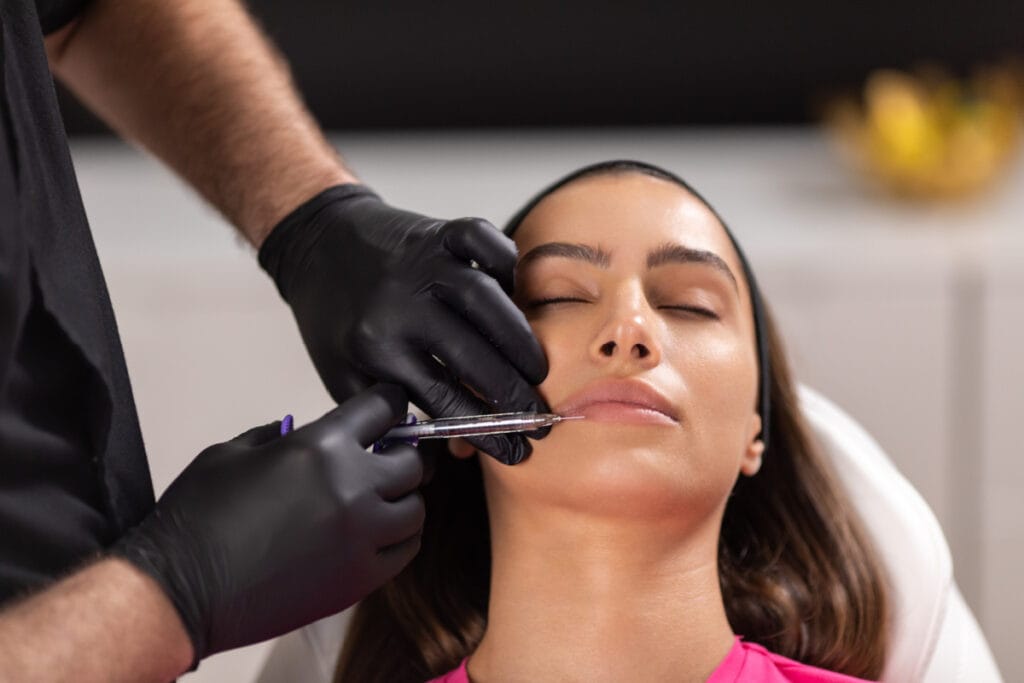
I inject hyaluronidase into the treated area, where it acts on the HA filler and allows the body to clear it. Depending on how much filler is present and where it sits, one session may be sufficient, or a follow-up treatment may be needed to address remaining volume.
One thing patients should know going in: hyaluronidase acts on HA indiscriminately, meaning it dissolves both the injected filler and some of the body’s naturally occurring hyaluronic acid in the area. The body replenishes this on its own, but some patients notice temporary hollowness after the filler is dissolved.
Radiesse: Time Is the Treatment
Radiesse is a calcium hydroxylapatite filler. It produces excellent results for volume replacement and has a longer duration than most HA fillers, but it doesn’t respond to hyaluronidase. For patients who’ve been overfilled with Radiesse, the body will break down and absorb the product on its own over time.
In some cases, steroid injections can help reduce firmness or irregularities while that process plays out.

“Dr Sobel also did Botox and filler injections for me. As a trained, certified, and experienced injectable RN I am extremely picky about who I allow to do this. Dr Sobel is the best I have ever seen.”
BOTOX: You’ll Have to Wait It Out
There is no equivalent to hyaluronidase for BOTOX. Once injected, the neurotoxin remains until the body metabolizes it, which is typically three to four months—sometimes longer depending on the dose and location. An overly frozen forehead, a dropped brow, or an asymmetric result will resolve on its own schedule.
Corrective BOTOX can manage some outcomes in the meantime. If one of your brows sits lower than the other, or if the treated forehead has created an unnatural arch pattern, strategic placement of additional BOTOX in adjacent muscles can rebalance the result while you wait. This requires the injector to have a thorough understanding of the underlying anatomy; it is not a technique to attempt without it.
When Dissolving Isn’t Enough
Some patients who come in for filler correction find that the real issue is structural. Years of adding volume to compensate for tissue descent has masked what the face actually needs: repositioning, not more filling. Filler correction may be a starting point for significant jowling, midface descent, or laxity around the neck, but it is rarely a complete answer to these signs of aging.
A facelift addresses the underlying tissue architecture in ways that injectable treatments simply cannot replicate. Dissolving overfilled cheeks and then adding appropriate, anatomically-placed volume through fat transfer is particularly effective, and I’ve published research on the intraoral fat grafting technique specifically because of how well it performs in terms of reduced bruising, zero injection marks, and patient comfort during recovery.
Every patient I see for correction receives a thorough evaluation before any product is used.
What a Corrective Consultation Involves
When a patient comes to me for filler or BOTOX correction, I start by listening. What was injected? Approximately when? What about the current result bothers you?
From there, I examine the tissue carefully: texture, symmetry, how the product has distributed, whether there are signs of migration, and what the underlying anatomy looks like.
Sometimes that means selective dissolution of one area. Sometimes it means a full reset followed by a waiting period before any new treatment makes sense. Sometimes the conversation turns to whether your goals would genuinely be better served by a surgical approach.
The goal is to get you back to looking like yourself.
At our Bellevue practice, I personally perform all injectable treatments, including hyaluronidase dissolution. If you’re unhappy with results from a previous provider, schedule a complimentary consultation and we’ll work through your options together.
Give us a call at (425) 453-9060 or contact us online.